Copy trading has transformed how retail traders and signal providers approach the markets, but success depends on having the right infrastructure. We’re excited to share several new features that address real challenges our community has been facing. These updates bring more control, flexibility, and precision to your trading operations.
Live Delay: Better Control Over Trade Timing
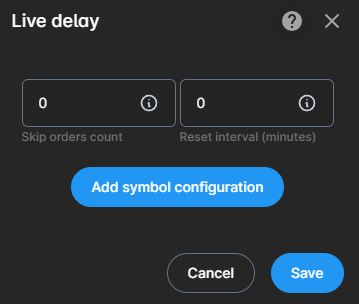
The new Live Delay feature gives you precise control over when trades are copied from master accounts to follower accounts. Rather than copying every single trade immediately, you can now skip the first few trades and set an automatic reset interval for the skip counter.
This matters more than you might initially think. Grid trading strategies have become increasingly popular, especially in volatile crypto and forex markets. These strategies work by placing multiple orders at predetermined price intervals, essentially creating a “grid” of positions designed to profit from market oscillations. The challenge? The first few entries in a grid often face the highest risk of getting stopped out during initial market noise or false breakouts.
Consider a typical scenario. A master account running a grid strategy places ten orders as price moves through various levels. The first two or three positions might get triggered and then stopped out quickly as the market whipsaws. But positions four through ten capture the actual trend and perform well. With Live Delay, you can skip those risky early entries and begin copying only after the strategy has proven its direction.
Many experienced traders who use grid strategies on major currency pairs like EURUSD skip the first two trades by default. They also set their skip counter to reset every 24 hours. Why? This approach helps them avoid the volatility around market opens and overnight gaps, which often create false signals that don’t reflect the actual trend.
The strategic value becomes clear when you look at performance data. Grid strategies that use delayed entry mechanisms tend to experience significantly lower drawdown in the first month of operation compared to strategies that copy all trades immediately. This happens because you’re filtering out false starts and market noise, entering after the initial volatility settles, and getting a chance to observe the master account’s actual performance before committing your capital.
This transforms copy trading from a passive “set it and forget it” approach into something much more strategic and risk aware. You’re no longer blindly following every move. Instead, you’re selectively engaging with the strategy at points that make sense for your risk tolerance and market view.
Enhanced Risk Limiter: Layered Protection That Makes Sense
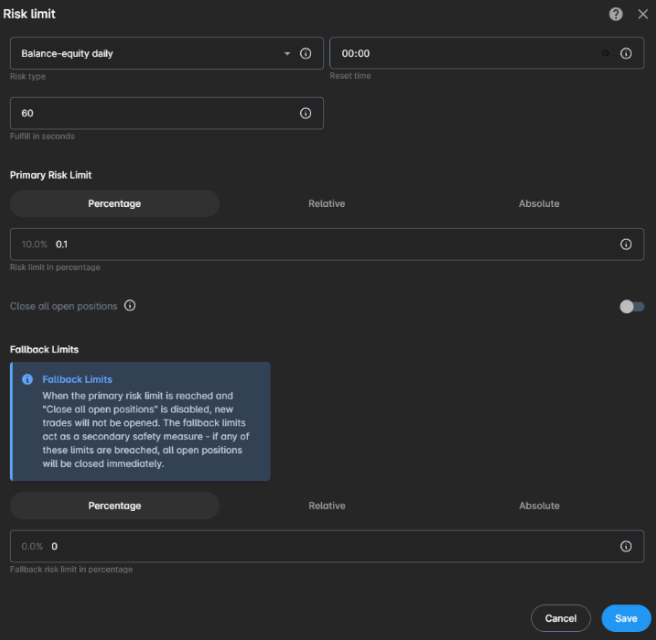
Risk management is never one size fits all, which is exactly why we’ve upgraded the Risk Limiter with a more sophisticated approach. The new system supports layered protection through a two tier structure that responds proportionally to different levels of drawdown.
Here’s how it works. You can now set a warning level that stops copying new trades when drawdown reaches your first threshold, let’s say 2%. But instead of being forced to close everything at that point, your existing positions remain open and have a chance to recover. If things get worse and drawdown reaches your emergency threshold of 4%, the system then closes all positions to prevent further damage.
This graduated approach mirrors what professional traders and hedge funds actually do. They don’t panic at the first sign of trouble, but they also don’t let losses run unchecked. The key is having escalating responses based on how serious the situation becomes.
Traditional risk limiters forced an uncomfortable choice. You could either stop copying trades or close everything completely. But what if you wanted something in between? What if you wanted to pause new risk while giving current positions room to recover? That’s exactly what this update provides.
The real world impact of this kind of layered risk management shows up in account survival rates. Retail trading accounts that use multi level stop mechanisms tend to survive significantly longer than those with only single level stops. The reason comes down to avoiding two common mistakes. First, you’re not panic liquidating positions that might have recovered if given a bit more time. Second, you’re still protecting against catastrophic losses by maintaining a hard stop at your emergency level.
When you’re setting up these levels, a good rule of thumb is making your emergency threshold about 1.5 to 2 times your warning threshold. This gives your positions breathing room while still maintaining clear boundaries. Of course, different strategies require different cushions, which is why testing your fallback levels on a demo account first is essential.
ARM Support: Deploy on Your Terms
The addition of ARM compatible Docker images for the My Home IP feature opens up some interesting possibilities, especially for traders who value cost efficiency and control over their infrastructure.
You can now run MetaCopier’s IP authentication on Raspberry Pi devices (models with at least 2GB of RAM work well), ARM based cloud servers like AWS Graviton or Oracle Cloud ARM instances, and Apple Silicon Macs with M1, M2, or M3 chips running natively.
Why does this matter? Cost is one obvious reason. A Raspberry Pi 4 costs around $75 as a one time purchase and consumes just 5 to 8 watts of power. Compare that to a traditional VPS that runs $10 to $20 monthly. Over a year, you’re looking at saving somewhere between $120 and $240 with zero recurring costs after buying the hardware.
But there are other benefits beyond just cost savings. ARM processors provide lower latency when running on local networks, which can matter for time sensitive trading operations. You also get higher reliability because you’re not dependent on external VPS providers who might have downtime or service issues. And from a security perspective, running your own infrastructure means you maintain complete control over your setup.
The broader industry trend supports this direction. Major cloud providers have been betting heavily on ARM architecture. AWS Graviton processors now power a substantial percentage of new EC2 instances, and performance benchmarks consistently show ARM chips delivering better price to performance ratios than traditional x86 alternatives for similar workloads.
For traders running multiple copiers or algorithmic strategies, ARM based infrastructure is quickly becoming the practical choice. It’s efficient, it’s cost effective, and it gives you the flexibility to scale without proportionally increasing your hosting expenses.
Marketplace Score: Choosing Signals More Intelligently
Finding the right signal provider can completely change your copy trading results, which is why we’ve introduced the Marketplace Score. This comprehensive metric evaluates signal providers across several important dimensions rather than just looking at headline profit numbers.
The algorithm takes into account consistency, meaning it looks at profit regularity rather than just total returns. It evaluates how providers manage drawdown, including maximum drawdown levels and how quickly they recover. The system measures risk adjusted returns using established metrics like Sharpe ratio and Sortino ratio. It also analyzes trade frequency to understand activity levels and typical position durations. Finally, it tracks follower retention as an indicator of whether copiers stick around over time.
This matters because most traders make a critical mistake when selecting signals. They focus almost exclusively on total profit percentage, but that number alone tells you almost nothing about sustainability or risk. A signal provider showing 500% gains but with 60% drawdown is objectively riskier than a provider with 80% gains and only 10% drawdown. The second provider offers a much better risk adjusted return even though the raw profit number looks less impressive.
Signal providers who rank in the top tier of Marketplace Score tend to maintain profitability over longer periods at much higher rates than providers selected purely on returns. The score helps you distinguish between sustainable trading strategies and lucky streaks that won’t last.
Additional Improvements Worth Knowing About
Several smaller updates round out this release, each addressing specific pain points we’ve heard from our community.
The Copier List View on master accounts now lets you see all connected copiers in one place. You can monitor performance across all followers, make bulk adjustments when needed, and quickly spot any accounts that are behaving unexpectedly. If you’re running a signal service with twenty or more followers, this single view will save you hours of administrative work every week.
The Display Equity Credit/Bonus Toggle addresses a common source of confusion. Many brokers offer credits or bonuses that inflate equity figures on your account dashboard. The new toggle lets you view equity with the credit included if you want that psychological boost, or view your actual equity without the credit when you need accurate performance tracking. When you’re calculating risk per trade or evaluating strategy performance, knowing your real equity becomes essential.
Risk Per Trade Grouping helps if you’re trading correlated currency pairs. For example, EURUSD and GBPUSD move together about 85% of the time. If you risk 1% on EURUSD and another 1% on GBPUSD without considering correlation, you’re essentially taking on close to 2% risk on the same market move. The grouping option lets you combine these related positions so your total risk stays at 1% across both.
The Manual Trades with Martingale update solves an interesting edge case. Martingale strategies use progressive position sizing, typically doubling lot size after losses. If you place manual trades while running a Martingale copier, those manual positions could throw off the lot progression calculations. Now the system ignores manual trades for Martingale purposes, letting you take discretionary positions without affecting your automated strategy.
What This Means for Your Trading
These updates collectively represent meaningful progress in copy trading infrastructure. Whether you’re a retail trader automating your approach, a signal provider managing multiple followers, a prop firm scaling operations, or a developer building on specialized hardware, MetaCopier now offers tools that let you execute precisely, manage risk thoughtfully, and scale efficiently.
The emphasis throughout these features is on giving you more control and more options. Trading is personal. What works for one account or strategy won’t work for another. Having flexible tools that adapt to different approaches and risk profiles makes the difference between forced compromises and setups that actually match your needs.
Testing and Implementation
As with any new trading tools, we strongly encourage testing these features on demo accounts before deploying them with real capital. Demo testing lets you get familiar with how the features work, see how they perform under different market conditions, and calibrate your settings for your specific strategy without risking money.
Make sure to configure Live Delay and observe which trades get skipped. Set Risk Limiter levels and intentionally trigger them to see the response. If you’re planning to use ARM deployment, verify everything works on your test hardware first. Review how Marketplace Scores correlate with actual provider performance. And if you use Martingale strategies, test that manual trades stay separate from the lot size progression.
Most trading disasters don’t come from bad strategies. They come from misconfigured risk settings or misunderstanding how a tool operates. Taking time upfront to test properly will save you from expensive mistakes later.
Looking Forward
We built these features based on feedback from our community, and that conversation continues. What would you like to see in future updates? Advanced analytics dashboards that give deeper insight into performance? Machine learning based signal ranking that evolves as market conditions change? Support for additional crypto exchanges? Social trading features like leaderboards or strategy discussions?
Your input shapes where we focus development effort. If there’s a tool or feature that would make a real difference in how you trade, reach out through our support channels or drop your thoughts in the comments. We’re committed to staying ahead of what the market needs, and that means listening carefully to the people who use these tools every day.
Resources and Support
Complete setup guides for all these new features are available in our knowledge base at https://docs.metacopier.io/. If you run into questions or issues, you can reach our support team via email or the in-platform chat.
Thank you for being part of the MetaCopier community. Here’s to trading smarter, managing risk better, and having the tools you need to succeed.
Trade smart. Trade safe. Trade with MetaCopier.
SEO Keywords: MetaCopier updates, copy trading platform, grid trading strategies, risk management tools, live delay copy trading, ARM trading infrastructure, Raspberry Pi trading, signal provider marketplace, Martingale strategy, trading risk limiter, forex copy trading, crypto copy trading tools